Hunter Eyes vs Prey Eyes: A Visual Comparison
Compare hunter eyes vs prey eyes with labeled illustrations, a feature-by-feature table, and a photo checklist to understand your own eye area.
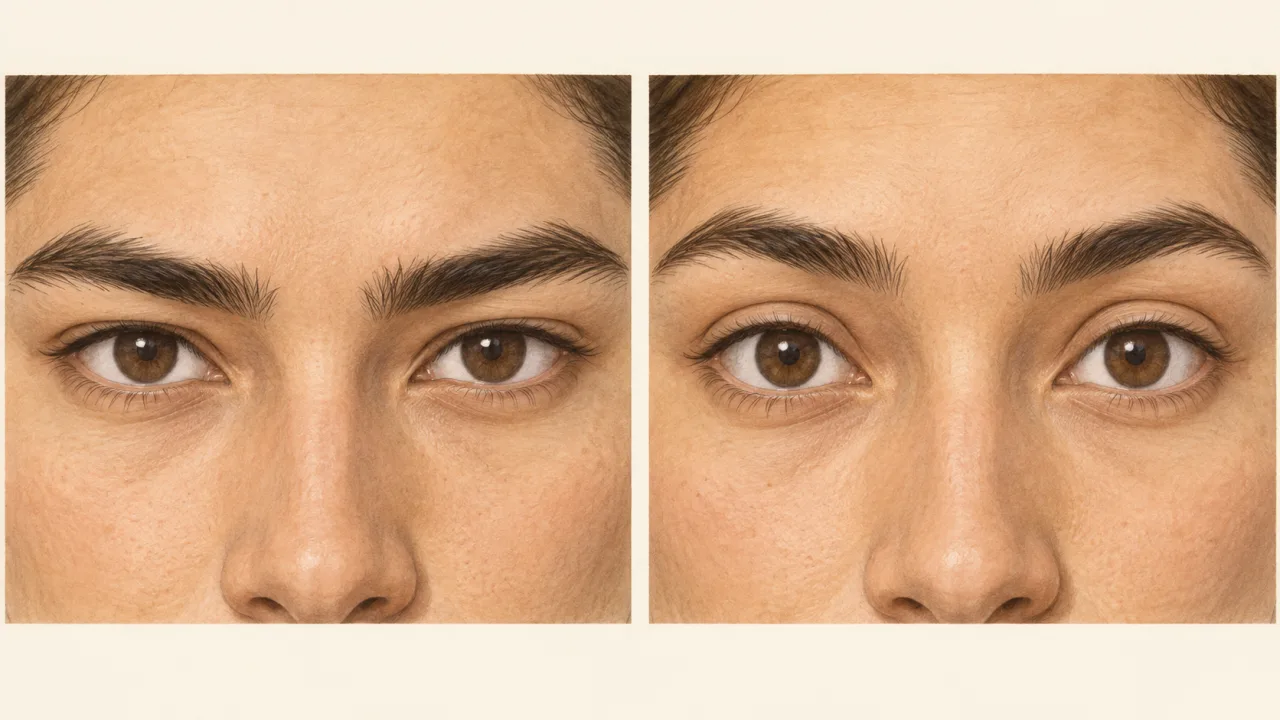
The main difference between hunter eyes and prey eyes is the combination of visible eye-area features. Online, “hunter eyes” usually describes a narrower, more hooded-looking eye area with level or upward outer corners and relatively close brows. “Prey eyes” usually describes a rounder, more open appearance with more visible upper eyelid skin. These are informal labels, and a person can have a mixture of the features associated with each.
This visual comparison explains what to look at, how to compare your own eyes, and where a photograph can mislead you. Neither label is a medical diagnosis or a measure of your overall attractiveness.
In this guide:
- The side-by-side comparison
- Four features to look at
- Compare your own eyes
- Why photos look different
- Attractiveness and changing your eye appearance
- Common questions
Hunter eyes vs prey eyes: the visual comparison
The illustration above shows two possible combinations under similar lighting and framing. Read the table as a guide to how people use the terms, not a checklist you must pass.
| Visible feature | Often described as “hunter” | Often described as “prey” |
|---|---|---|
| Eye opening | More elongated horizontally, with less visible height | Rounder, with more visible height |
| Eye-corner direction | Outer corner appears level with or above the inner corner | Outer corner may appear level with or below the inner corner |
| Upper eyelid skin | A smaller visible strip between the upper lashes and crease | A broader visible strip between the upper lashes and crease |
| Brow-to-eye relationship | Brows appear closer to the eyes | More visible space between the brows and eyes |
Notice that a level eye-corner direction appears in both descriptions. There is no universally accepted dividing line, and one feature does not settle the comparison. Rounder eyes can have upward outer corners; elongated eyes can have visible upper lid skin.
You may also see “deep-set eyes,” “brow ridge,” and “scleral show” in these comparisons. Those terms need separate explanations. A shadow under the brow is not a measurement of eye-socket depth, and visible eyelid skin is not the same thing as visible eye white.
Four eye-area features to compare
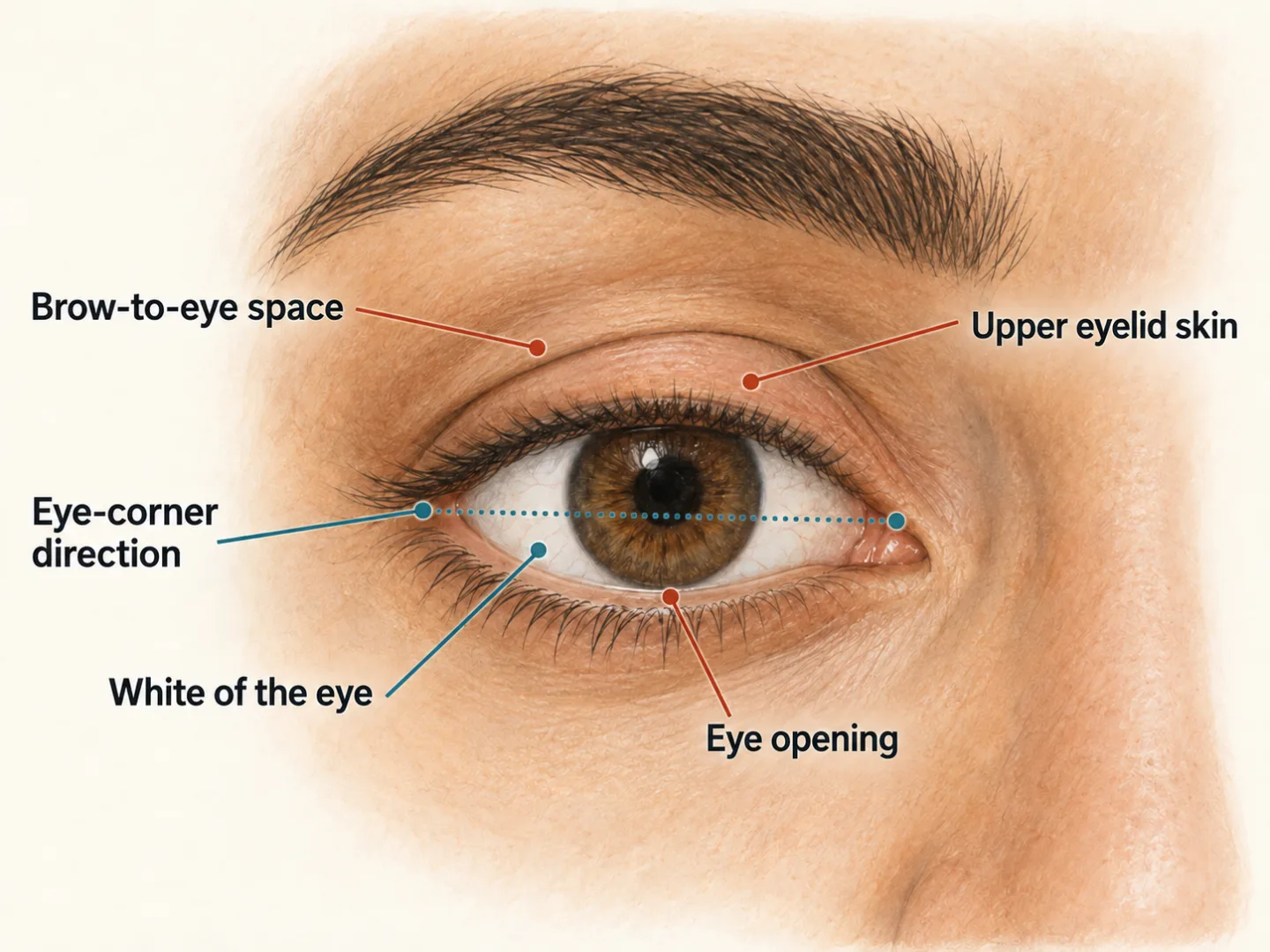
1. Eye opening shape
The eye opening, also called the palpebral fissure, is the area between the upper and lower eyelid margins. Look at whether it appears elongated, intermediate, or rounder while your face is relaxed.
This describes the visible opening, not the size of the eyeball. Squinting narrows that opening temporarily. Comparing a squinting photo with a wide-eyed photo would mix expression with the feature you are trying to observe.
2. Canthal tilt direction
The inner corner is next to the nose; the outer corner is toward the temple. Canthal tilt describes the direction of the line connecting them relative to a level reference:
- Positive: the outer corner is higher.
- Neutral: the corners are approximately level.
- Negative: the outer corner is lower.
Start with an upright, front-facing photo. If your head is tilted or one corner is hidden, the apparent direction may be unreliable. You do not need to assign an angle to describe what you can see, and an upward direction alone does not establish “hunter eyes.”
3. Upper eyelid exposure
Here, upper eyelid exposure means the skin you can see between the upper lash line and the eyelid crease. A fold can cover part of that skin, producing a more hooded appearance. If the crease is not visible, avoid guessing where it is.
This is different from scleral show: the sclera is the white of the eye, and these comparisons often refer specifically to white visible below the iris. A person can have visible upper lid skin without visible white below the iris. Do not count them as the same feature or treat either observation as a diagnosis.
4. Brow-to-eye relationship
Observe how close the lower brow edge appears to the eye. Raised brows, brow shape, and head position can change that relationship in a photograph.
This is not the same as brow-bone projection. Similarly, an eye area that looks shadowed does not let you measure orbital depth from an ordinary selfie. Describe visible spacing and shadows without inventing a bone measurement.
How to compare your own eyes in a photo
A useful self-check produces a few specific observations. It does not need to end in a permanent label.
- Prepare one clear portrait. Keep the camera at eye level, face forward, and hold your head upright. Use soft, even light and a relaxed expression. Keep both eyes and eyebrows visible, without a beauty filter.
- Look at the opening and lid skin separately. Is the opening elongated, intermediate, or rounder? How much upper lid skin is visible? Do not squint or raise your brows to match a reference image.
- Check both corners and brows. Describe the apparent eye-corner direction and brow spacing on each side. If hair, blur, or shadow hides a feature, record it as unclear.
- Read the combination. Note which traits occur together. A mixed description is more informative than choosing a category from whichever single feature catches your attention.
For example, a useful observation might be:
The eye openings look elongated and the outer corners appear slightly upward. Some upper eyelid skin is visible. A shadow obscures the brow edge, so its spacing is unclear.
That is a fictional example of mixed features, not a test result. It preserves what the image can show and leaves the uncertain part open. There is no need to turn three observations into a score out of four.
If you would like help describing a photo, try the free Hunter Eyes Test. It provides an overall description and four visible-feature observations, with photo limitations. It does not measure exact angles, eye-socket depth, or attractiveness. No signup is required for the eye-area result; a full-face PSL analysis is an optional next step.
Why your eyes can look different in photos
Before interpreting a change between two pictures, compare the conditions in which they were taken. A lowered chin, raised eyebrows, or a squint can alter the apparent opening and lid exposure without demonstrating a lasting structural change.
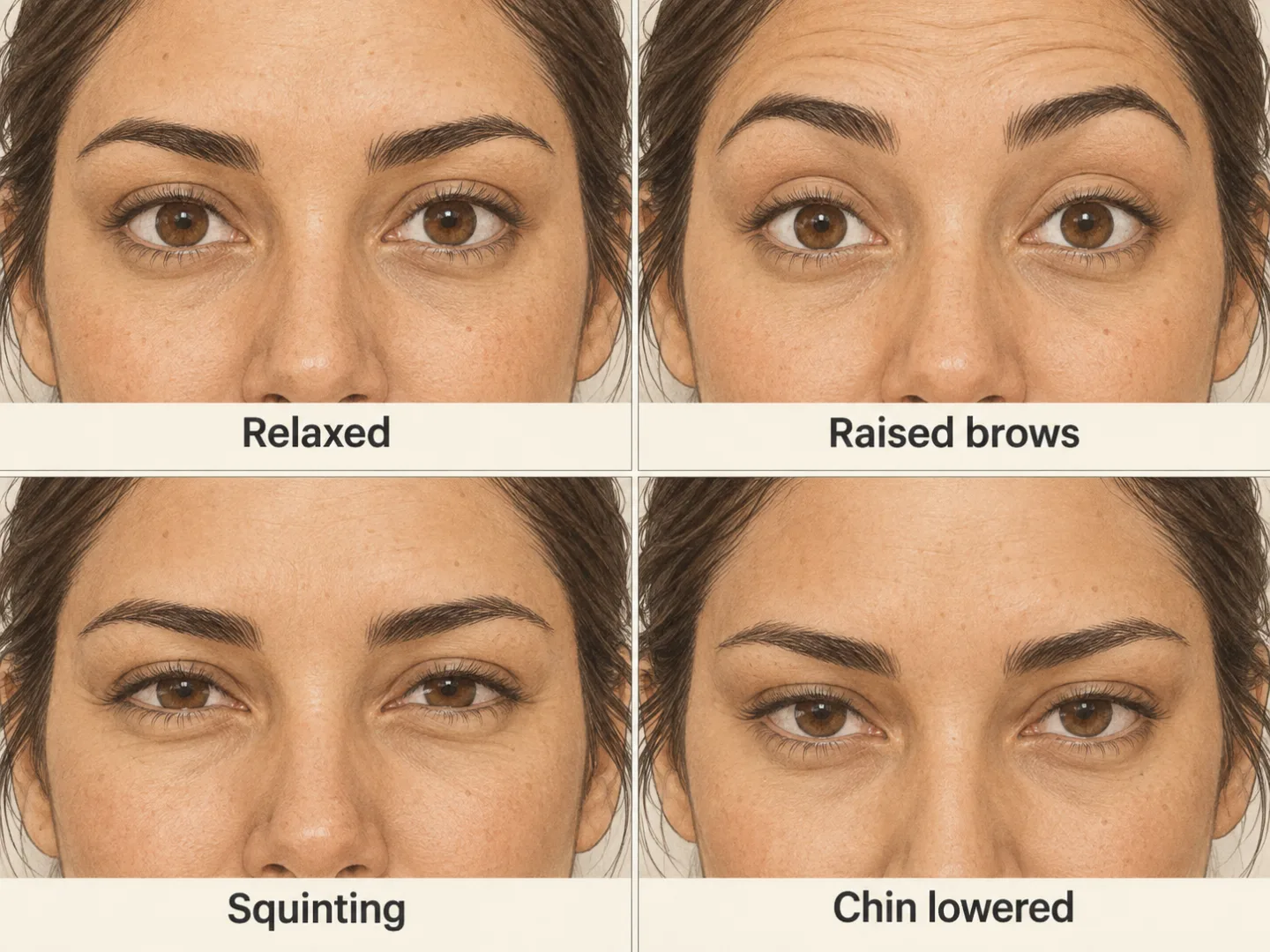
There is research directly relevant to this problem. In a study of sagittal head tilt by Vaca and colleagues, researchers photographed 12 female volunteers at different head positions. Downward head tilt reduced visible upper lid measures and increased the apparent upward eye-corner inclination. The study supports controlling head position when comparing eye-area photographs. It did not test the hunter/prey labels or an AI classification tool.
Lighting also changes which contours you can see. A dark shadow under a brow can suggest depth while hiding the eyelid crease. That is a reason to improve the lighting before drawing a conclusion about anatomy.
For a fair comparison, keep camera position, head position, expression, lighting, and framing similar. If an image is unclear, correct that specific problem. Repeatedly uploading different poses until you receive a preferred label will not identify a more accurate answer. Our guide to why AI face ratings vary between photos explains the broader issue.
Are hunter eyes more attractive than prey eyes?
Neither label establishes which face someone will find more attractive. The labels combine several features, while photographs also differ in expression, lighting, styling, and the rest of the face. A comparison between two celebrities cannot isolate the effect of eye shape.
That does not mean eye-area features have no influence on perception. For example, Bashour and Geist studied digitally modified female faces and found a preference for an accentuated medial canthal tilt in their experiment. That is a finding about a particular modification and judgment task. It is not evidence that everyone prefers “hunter eyes,” or that the same result applies to men, every face, or real-life attraction.
If you are asking whether “prey eyes” are bad, the label does not identify a flaw that needs fixing. It also cannot tell you whether a person is confident, timid, dominant, or approachable. Those are assumptions about a person, not observations of an eyelid.
The same caution applies when these terms are used for women. More open eyes, hooded lids, or upward corners can occur in many combinations. There is no single eye-type ranking that this informal vocabulary can reliably establish.
Can prey eyes become hunter eyes?
You can change how your eye area appears in a photograph through expression, brow styling, makeup, or lighting. For example, eyeliner can extend a visible contour, while a squint temporarily narrows the opening. Neither example demonstrates that the eye socket or resting anatomy has changed.
Be careful with claims that an exercise will permanently transform one “type” into the other. The American Association of Orthodontists explains that mewing's facial-reshaping claims lack scientific support. Its guidance does not establish mewing as a way to change eye anatomy, and a before-and-after selfie cannot supply that missing evidence.
Some medical procedures alter eyelid structures, but choosing one requires an individual clinical assessment. These internet labels and a photo-based test do not establish a reason for treatment or predict its outcome.
Common questions
Are hooded eyes the same as hunter eyes?
No. Hooding describes how a fold covers some upper eyelid skin. “Hunter eyes” bundles that appearance with other features, such as the eye opening and brow relationship. Hooded lids alone do not determine the whole description.
Can I have features of both hunter and prey eyes?
Yes. An elongated opening can occur alongside more visible upper lid skin, and rounder eyes can have upward outer corners. Describe the features separately rather than forcing them into matching columns.
Does negative canthal tilt automatically mean prey eyes?
No. It describes one direction, not the complete eye area. First check whether the head is upright and both corners are visible. Then consider the opening, lid skin, and brows separately.
Are hunter eyes rare?
There is no generally accepted definition or population cutoff behind the term, so a precise rarity percentage would need a defined method and a representative study. We do not have that evidence and do not estimate rarity from a photo.
Do humans really have predator or prey eyes?
“Predator eyes” is another informal name for the hunter-eye look. Animal vision research is a different subject: the UC Berkeley research described by the University of California examined pupil shapes and ecological roles across animal species. It did not divide human faces into hunters and prey. The animal metaphor should not be treated as human biological classification.
Sources and editorial note
- Vaca and colleagues: The Influence of Sagittal Head Tilt on Periorbital Appearance — head position and the comparability of eye-area photographs.
- Bashour and Geist: Is medial canthal tilt a powerful cue for facial attractiveness? — a specific experiment using modified female faces.
- American Association of Orthodontists: Does Mewing Actually Reshape Your Jaw? — evidence behind facial-reshaping claims.
- University of California: Hunter or prey? The eyes are the key — the scope of the animal pupil research.
Published by PSL Scale with AI assistance in research and drafting. Illustrations were generated with AI for this guide and depict fictional examples. The cited research does not validate our tool or establish the two labels as clinical categories.
To apply the four observations to your own portrait, you can use the free eye-area test and read its photo limitations alongside the result.